
Urbandale Epoxy Flooring installs ESD flooring in Urbandale, IA, serving surrounding cities including Clive, Grimes, Windsor Heights, Johnston, West Des Moines. With 20+ years of coating central Iowa slabs, we build static-dissipative and conductive epoxy floors for electronics assembly, repair benches, labs, server rooms and other spaces where a static spark can damage a component or disrupt equipment.
An ESD floor, short for electrostatic discharge, is a working part of a static-control program. It carries charge from people, carts and equipment down through the coating to a grounding grid and on to building ground, so the charge drains away instead of building up and jumping to a sensitive part.
Because the floor has an electrical job, its proposal says more than color and thickness. It names the resistance range the floor is designed to meet, the grounding layout, the product layers and the test method we will use to verify the floor before it goes back into service.
How an ESD Floor Works
Static-Dissipative and Conductive Ranges
Static-control floors are grouped by their electrical resistance. Conductive floors sit at the low end and move charge quickly, while static-dissipative floors sit in a higher resistance range and drain charge in a slower, more controlled way. Programs built around the ANSI/ESD S20.20 standard set the ranges a floor and footwear must meet together.
We start from the program the floor has to serve, not from a product brochure. An electronics line, a data room and a lab may each call for a different range, and the floor is specified to the one your quality or IT team actually works to.
Floor and Footwear as One System
A floor drains charge from a person only through what that person is wearing. Conductive shoes, heel straps or shoe grounders complete the path, and most ESD programs test the person, footwear and floor together. A perfect floor under ordinary rubber-soled shoes does very little.
That is why we ask about footwear at the start. Carts and chairs need conductive wheels or drag chains as well, and the floor plan notes where each will travel.
Where Static Control Matters
Electronics assembly and repair benches are the classic case, since a discharge too small for a person to feel can weaken or destroy a circuit board. Server rooms, telecom closets, labs with sensitive instruments and areas where flammable vapors are handled can all call for static control as well.
Not every room in a building needs it. We often coat the ESD area as its own zone, marked off by color or a border line, and use a standard epoxy or polished concrete in the surrounding corridors and offices, which keeps the cost of the static-control system where it does real work.
How We Build an ESD Epoxy Floor
Grinding and Moisture Testing
An ESD system starts with the same preparation as any coated floor. The slab is diamond ground to a measured profile, cracks are filled and ground flush, and the slab is tested with ASTM F1869 or F2170 methods. A failed bond or moisture blisters break the conductive path, so preparation matters doubly here.
Dust is captured at the machine by vacuum, which matters in a building that already houses electronics. Work areas are sealed off from the rest of the space while we grind.
Copper Grounding Grid
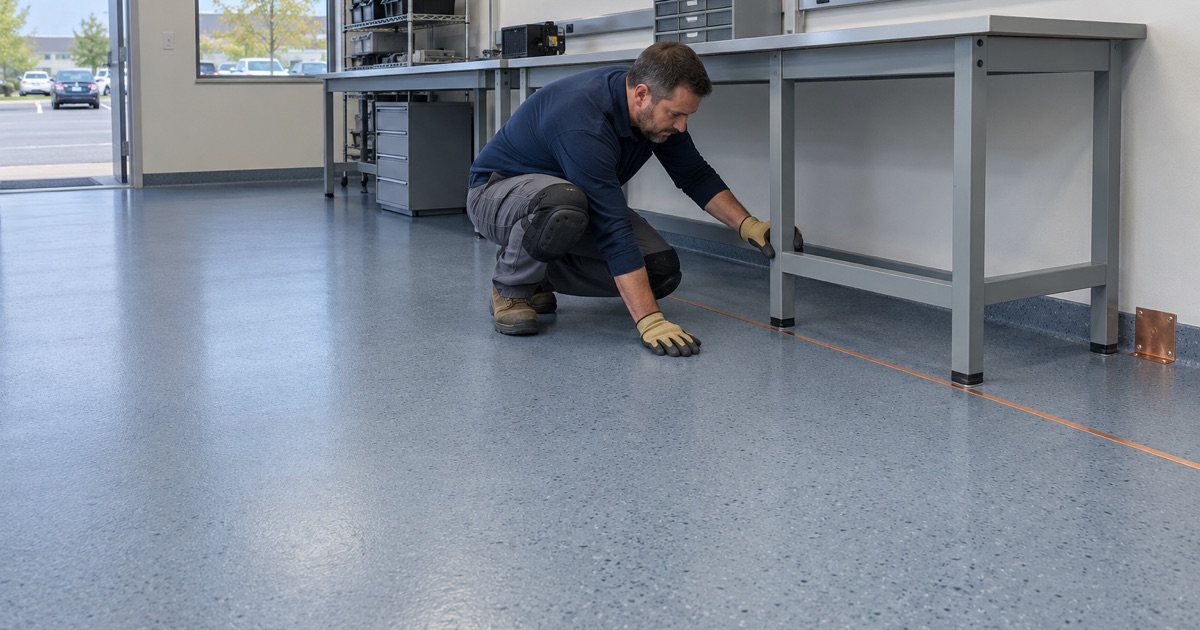
A grid of conductive copper tape is laid across the slab and connected to building ground at set points, often at a grounding bus or a known building ground. The spacing and number of connection points come from the system maker’s instructions and the size of the room.
We mark the grounding points on a floor plan and leave it with you. When an electrician or facility manager later needs to confirm the ground path, the plan shows exactly where the floor is tied in.
Conductive Primer and Static-Control Topcoat
A conductive primer goes over the grid and carries charge across the slab to the copper. The static-control epoxy layer on top carries charge from the surface down through the coating, and it is applied to a controlled thickness, because too much or too little build can move the floor out of its range.
Our proposals name each of those layers and the finished thickness. That way the system installed can be checked against what was specified, layer by layer.
Testing and Care
Resistance Testing Before Handover
After cure, we measure resistance with a surface resistance meter and electrodes at points across the floor, including point-to-ground readings near and far from the grounding connections. The readings are recorded on the floor plan and handed over with the job.
Those results show whether the floor meets its range before equipment and people return. They also give the facility a baseline to compare against during periodic checks.
Cleaning Without Insulating the Floor
Wax, floor finishes and many common cleaners leave an insulating film that raises the floor’s resistance. An ESD floor needs cleaners meant for static-control surfaces and should never be waxed. We leave written care instructions so a janitorial crew does not undo the floor’s performance with the wrong product.
Walk-off mats at the entries help too, because grit and dirt tracked onto the floor wear the static-control layer and leave a film of their own. A floor that is kept clean with the right products holds its range far longer than one that is mopped with whatever is on the janitor’s cart.
Planning Around Live Equipment
Server rooms and production areas rarely shut down for long. We phase work around equipment and business hours, use night and weekend windows where a space cannot close, and plan grinding and odor control so sensitive equipment and the people who run it are protected while we work.
Benches, racks and cabinets have to move for a full floor, so we work with the facility team on a sequence that keeps critical equipment running. Sometimes that means coating one half of a room, moving equipment across, and finishing the second half on a later night.
- 20+ Years on Iowa Slabs
- Moisture Tested Before Pricing
- Coats and Thickness in Writing