Urbandale Epoxy Flooring installs commercial epoxy flooring in Urbandale, IA, serving surrounding cities including Clive, Grimes, Windsor Heights, Johnston, West Des Moines. With 20+ years of coating business floors across central Iowa, we work in flex bays, offices, clinics, retail stores, service shops and warehouses, and we plan each job around the people who still have to use the building while we work.
A commercial floor carries more traffic, more chemicals and a tighter schedule than a home garage. That changes the system we specify and the way we run the job, but it does not change the order of the work: the slab is ground, tested and repaired before any coating goes down, and the proposal names the product line, the number of coats and the finished thickness.
The proposal also includes a phasing plan. Each area is listed with the days it closes, the cure time it needs, and the time it returns to service, so a manager can plan staff, customers and deliveries around the floor rather than the other way around.
Commercial Spaces We Coat
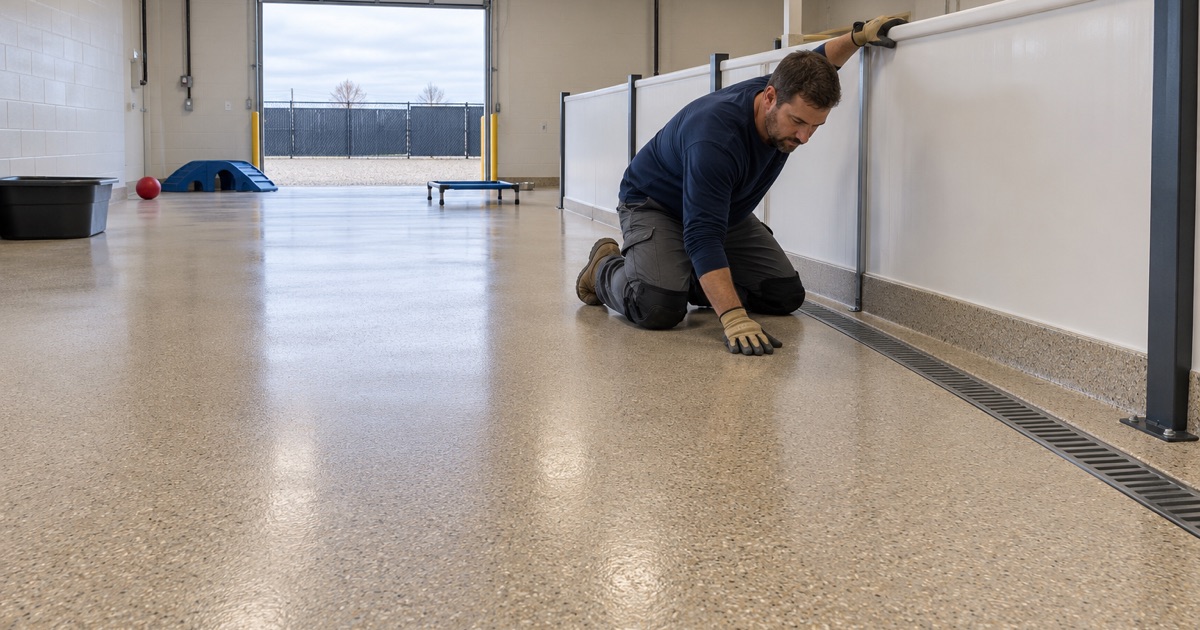
Office-Front, Warehouse-Back Flex Bays
Urbandale’s business parks are full of small-bay flex buildings with office space in front and warehouse space behind, leased in bays of a few thousand square feet. Aurora Business Park, the city’s second-largest taxpayer, is built on exactly that model, with buildings dating from 1986 onward.
In a flex bay, the warehouse slab outlives every tenant. A bay that held a sign shop, then a contractor, then a showroom may carry sealers, paint, mastic or an old coating from each, and what the last tenant left decides whether a new coating can bond. We grind a test area and check the slab before pricing.
Offices, Lobbies and Corridors
Lobbies and corridors are the floors visitors judge a business by. We install metallic, flake and solid-color systems that look finished, handle rolling chairs and carts, and clean easily with a mop, and we work in sections so the building stays usable.
In occupied offices, we use low-odor products and plan ventilation with the building manager. We also schedule the noisiest grinding for nights and weekends when the fewest people are there.
Clinics and Dental Offices
Medical and dental spaces need floors that clean and disinfect reliably. CDC infection-control guidance for dental settings treats floors as housekeeping surfaces cleaned with detergent and water and disinfected when soiled with blood, and it advises avoiding carpet in operatories, labs and instrument-processing rooms because carpet cannot be reliably disinfected.
A seamless resinous floor with an integral cove base leaves no seams or grout lines for contamination to collect in. Urbandale has seen newer dental and eye-care buildings go up along Douglas Parkway and near 128th Street and Hickman Road, and spaces like those are where a seamless floor earns its place.
Retail and Showroom Floors
Retail floors have to be coated without closing the store. We phase the work into enclosed sections, often early in the morning or overnight, and pick systems with cure times that let fixtures go back on schedule.
Showroom floors also have to look good under bright lights, so we pay attention to sheen. A satin topcoat hides scuffs and dust between cleanings, while a gloss finish gives a sharper look for spaces that are cleaned daily.
Choosing a Commercial System
Epoxy, Polyaspartic and Urethane Cement
A 100% solids epoxy base builds thickness and bonds well to a ground slab. A polyaspartic or urethane topcoat adds abrasion resistance and color stability, and urethane cement handles hot water, steam cleaning and harsh chemicals that would soften an epoxy.
We choose the system from what will actually land on the floor: foot traffic, carts, forklifts, fluids, cleaning chemicals and temperature. The proposal explains why each layer was chosen, so the floor can be compared fairly with another bid.
Slip Resistance by Specification
In entries, wash areas and anywhere water reaches the floor, slip resistance matters. We specify it through the broadcast and topcoat used, such as a quartz aggregate broadcast or a grit additive, rather than promising a floor is non-slip as a slogan.
The texture is a trade-off with cleaning. A more aggressive texture grips better but holds more dirt, so we set it for each area rather than coating the whole building the same way.
Moisture and Old Slabs
Commercial slabs are often older and may sit on grade with no vapor retarder under them. We test with ASTM F1869 or F2170 methods before pricing, and where the reading is high we use a moisture-mitigation primer. What a coating warranty excludes, moisture vapor transmission first, is explained before the job is sold.
Running a Commercial Job
Phasing Around Tenants and Hours
Flex bays, offices and warehouses are phased around tenants and business hours, with night and weekend windows when a space cannot close. Each phase is scheduled to its own cure time, so the next morning starts on a usable floor.
Dust Control and Clean Work
Grinding dust is captured at the machine by vacuum rather than swept or washed toward a floor drain or a storm inlet. Work areas are closed off with barriers, and the rest of the building stays clean while we work.
Leases, Codes and Change of Use
A floor coating alone is finish work, but a change in how a space is used can bring the 2018 IEBC and a building permit into play in Urbandale. In leased space, the lease decides who may change the floor and what must be restored at move-out, so we provide a written scope a tenant can share with the property manager.
- 20+ Years on Iowa Slabs
- Moisture Tested Before Pricing
- Coats and Thickness in Writing